
Improving your marks in A Level Physics 9702 Paper 4 is not only about memorising formulas or completing as many past papers as possible. Paper 4 requires students to understand Physics concepts, apply equations correctly, explain ideas clearly, interpret information and solve unfamiliar problems.
If you are regularly losing marks even after studying the syllabus, the problem may be your exam technique rather than your Physics knowledge. Small issues such as missing units, incorrect sign conventions, incomplete working, weak explanations or misreading a question can cost valuable marks.
This guide explains how to improve A Level Physics 9702 Paper 4 marks through better question technique, mark scheme analysis, targeted practice and systematic mistake correction.
What Does Cambridge A Level Physics 9702 Paper 4 Test?
Cambridge International A Level Physics 9702 Paper 4 is the A Level Structured Questions paper. It assesses knowledge and understanding of A Level Physics and requires students to apply Physics ideas to structured and unfamiliar problems. Cambridge also emphasizes understanding concepts and applying Physics ideas in novel contexts rather than relying only on memorisation.
Paper 4 questions can require you to perform calculations, explain physical processes, derive or use equations, interpret graphs, analyse data and apply concepts to situations you have not seen before.
This means effective 9702 Paper 4 preparation should include three things:
- Strong understanding of Physics concepts
- Accurate mathematical and scientific working
- Regular practice with examination-style questions
Before attempting difficult past papers, make sure your basic concepts are secure. You can use the Cambridge A2 Level Physics notes on Physics With Yameen to revise important topics, equations and definitions.
10 Common Reasons Students Lose Paper 4 Marks
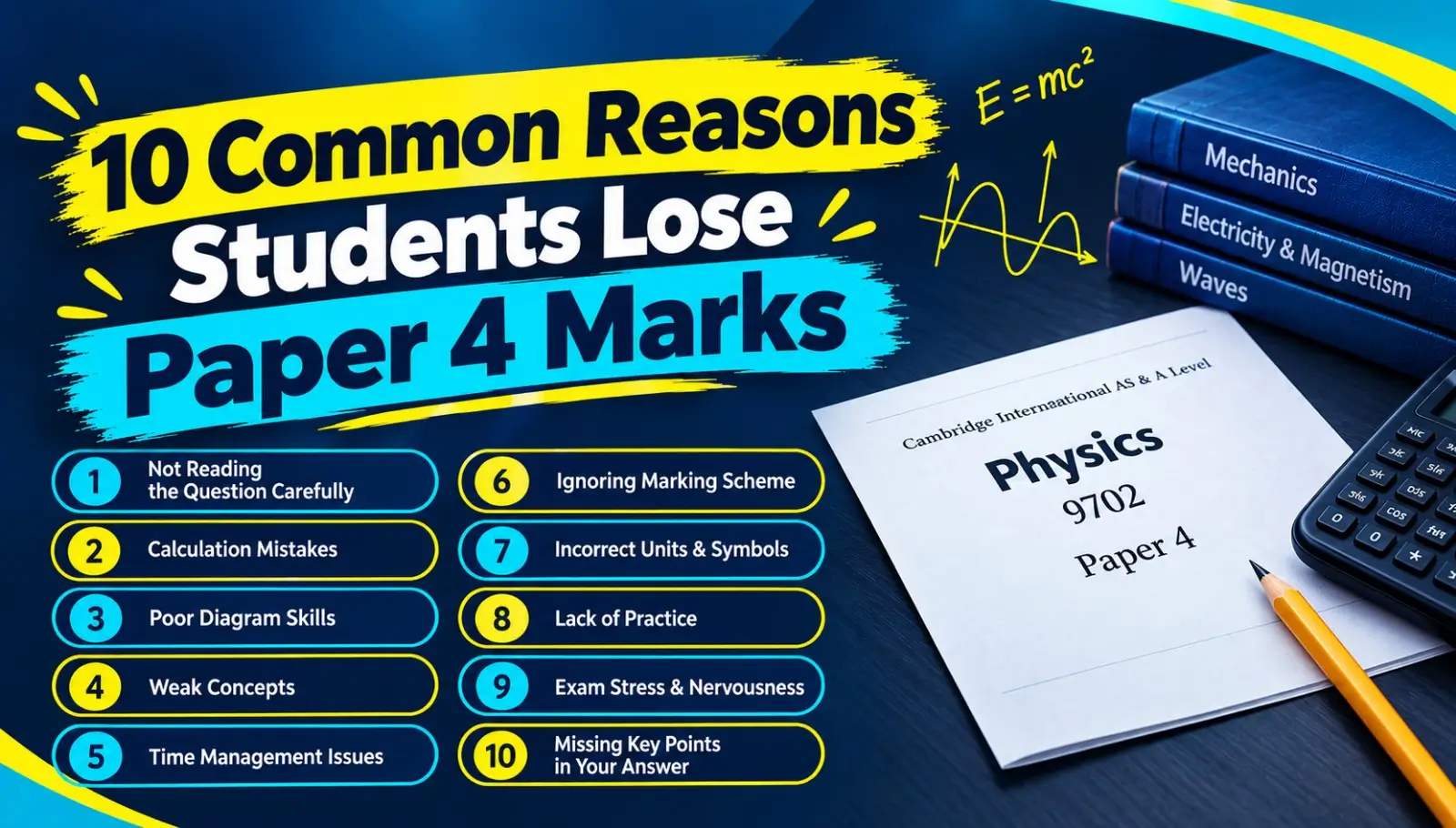
Students can lose marks for reasons that are not always related to a lack of Physics knowledge. Understanding these common Physics mistakes can help you identify where your marks are disappearing.
1. Using Incorrect Sign Conventions
Sign conventions are particularly important in topics involving gravitational potential, electric potential, energy and motion.
For example, gravitational potential and gravitational potential energy can involve negative values. The Cambridge 9702 syllabus includes the relationships for gravitational potential and gravitational potential energy, so students need to understand what the signs represent rather than simply memorising the equations.
Always check:
- What direction is positive?
- Is the quantity a scalar or vector?
- Does the equation require a positive or negative value?
- Does your final answer make physical sense?
2. Not Showing Enough Mathematical Working
Writing only the final numerical answer can make it difficult to demonstrate how you reached your result.
For Paper 4 calculations, show the important working steps:
- Write the relevant equation.
- Substitute the values.
- Perform the calculation.
- Give the final answer with the correct unit.
Clear mathematical working also makes it easier to identify where you made an error during past paper analysis.
3. Forgetting Units and Significant Figures
A numerical answer is not always complete without its unit.
Pay attention to:
- SI units
- Derived units
- Prefixes
- Significant figures
- Scientific notation
For example, make sure that quantities such as energy, charge, resistance, field strength and frequency are expressed with appropriate units.
If you need to revise SI units, measurements and significant figures, the Physical Quantities & Units AS Physics notes can help strengthen this foundation.
4. Giving Vague Answers to Explain Questions
An explanation question requires more than repeating words from the question.
A strong Physics explanation should connect a physical principle to the situation described.
Instead of writing a general statement, identify:
- What physical quantity changes
- Why it changes
- Which Physics principle explains the change
- What effect this produces
Use accurate scientific terminology rather than everyday language.
5. Struggling With “Show That” Questions
A “show that” question normally gives you a target value and asks you to demonstrate that the given information leads to that value.
Do not simply write the final answer.
Show the equation, substitution and calculation clearly. If a conversion or intermediate result is required, include it.
6. Misreading Graphs and Data
Graphs can contain important information that students overlook.
Before calculating anything, check:
- Axis labels
- Units
- Scale
- Gradient
- Intercept
- Data trends
- Significant figures
When a question asks you to interpret experimental data, explain what the data actually shows rather than making assumptions.
7. Using the Wrong Physics Equation
Knowing many equations does not automatically mean you know when to use them.
Before choosing an equation, identify:
- What information has been provided?
- What quantity is required?
- Which Physics principle connects them?
- Are all quantities in compatible units?
Understanding the concept behind an equation is more useful than memorising equations without knowing their application.
8. Missing Key Points in Definition Questions
Physics definitions require precise scientific language.
Avoid overly short definitions that leave out an essential condition.
Revise important definitions from your syllabus and practise writing them accurately from memory.
9. Weak Mathematical Working
A Physics problem may require algebra, rearranging equations, powers, logarithms, ratios or graphical calculations.
Weak mathematical skills can turn a Physics question into a calculation error.
Practise mathematical steps alongside Physics concepts so that you can concentrate on the Physics during the examination.
10. Struggling With Unfamiliar Physics Questions
One of the biggest challenges in A Level Physics is applying familiar concepts to unfamiliar situations.
Do not panic when a question looks different from something you have practised.
Break it into smaller parts:
- What information is given?
- What is being asked?
- Which Physics concept is involved?
- Which equation or principle applies?
- What does the result mean physically?
This approach helps you apply Physics concepts instead of relying on memorised question patterns.
How to Answer 9702 Paper 4 Questions for More Marks
A mark scheme should not only be used to check whether your final answer is correct.
Use the Physics 9702 mark scheme as a learning tool.
After completing a question, compare your answer with the mark scheme and ask:
- Which marks did I receive?
- Which marks did I miss?
- What point was missing?
- Was my equation correct?
- Did I include the required unit?
- Was my explanation sufficiently precise?
- Did I use the correct Physics terminology?
Cambridge also provides revision materials that include example candidate responses and topic questions with mark schemes through its learning resources.
Do not simply read the mark scheme and move on. Rewrite the question and attempt it again using the correct method.
That second attempt is where much of the learning happens.
How to Analyse Your Mistakes After Every Physics Past Paper
Completing a past paper is only half of the process.
The real improvement comes from analysing your mistakes.
Create a simple Paper 4 mistake log with columns such as:
| Question | Topic | Mistake | Correct Method | Action |
|---|---|---|---|---|
| Q3 | Electric Fields | Wrong equation | Use correct relationship | Revise topic |
| Q6 | Oscillations | Missing unit | Add SI unit | Check units |
| Q9 | Gravitational Fields | Sign error | Review sign convention | Practise 5 questions |
Look for recurring patterns.
If you repeatedly lose marks because of units, focus on units.
If you repeatedly struggle with unfamiliar questions, practise more application-based problems.
If your calculations are correct but explanation marks are low, work on scientific language and command words.
The goal is not simply to complete more papers. The goal is to make fewer repeated mistakes.
The Best Way to Practise A Level Physics 9702 Paper 4
Effective 9702 Paper 4 practice should progress from focused questions to complete examination papers.
Start With Topical Questions
Begin with topics where you are losing marks.
Physics With Yameen provides A2 Level Physics topical past papers organized by topic, including areas such as Electric Fields, Gravitational Fields, Magnetic Fields, Motion in a Circle, Oscillations, Capacitance and Quantum Physics.
Topical Physics questions allow you to identify weaknesses without the pressure of completing an entire paper.
Move to Full Past Papers
Once your weak topics improve, start completing complete Paper 4 past papers.
Try to simulate the examination environment:
- Use the appropriate time limit.
- Work without notes.
- Avoid checking solutions during the paper.
- Complete every question.
- Mark the paper afterwards.
Practise Under Exam Conditions
Timed exam practice is important because knowing Physics and performing well under examination conditions are different skills.
During timed practice, work on:
- Reading questions efficiently
- Managing your time
- Showing enough working
- Moving on when stuck
- Returning to difficult questions
- Checking your answers
Keep a Paper 4 Mistake Log
Record every significant mistake.
After several papers, your mistake log will show which topics and exam skills require the most attention.
How to Improve Your Paper 4 Marks in 30 Days
A structured 30-day revision plan can help you improve without randomly jumping between topics.
Days 1–7: Identify Weak Areas
Complete selected topical questions and identify your weakest areas.
Review your notes and equations for those topics.
Days 8–14: Target Your Weak Topics
Complete more topical Physics questions.
Focus particularly on:
- Calculations
- Definitions
- Explanations
- Graphs
- Derivations
- Unfamiliar applications
Days 15–21: Start Full Paper Practice
Complete full Paper 4 past papers under timed conditions.
After each paper, analyse every mistake.
Do not count a paper as completed until you have reviewed it.
Days 22–30: Exam Simulation
Complete additional timed papers and focus on your recurring mistakes.
Your final revision should be based on evidence from your mistake log rather than simply revising every topic equally.
For additional concept revision, you can use the free Cambridge Physics resources on Physics With Yameen, which include notes, topical past papers, worksheets and revision material.
Paper 4 Exam-Day Strategy
On examination day, focus on accuracy and clear communication.
Read the Question Carefully
Pay attention to command words such as:
- Calculate
- Determine
- Explain
- Describe
- Show that
- Derive
- State
The wording tells you what type of response is expected.
Show Your Working
For calculations, write enough working to demonstrate your method.
Check Units
Before moving on, check whether your numerical answer needs a unit.
Check Significant Figures
Do not give unnecessarily rounded answers.
Manage Your Time
Do not spend too long on one difficult question.
If you are stuck, move forward and return to it later.
Check Your Answers
If time remains, check:
- Signs
- Units
- Powers of ten
- Significant figures
- Calculator entries
- Graph values
- Whether every part of the question was answered
Cambridge 9702 Paper 4 Practice Resources
A strong revision system combines concept learning with question practice.
Physics With Yameen provides several resources that can support your A Level Physics 9702 preparation.
Start with the A2 Level Physics Notes to review concepts, equations, definitions and topic summaries. The current A2 resource covers topics including Circular Motion, Gravitational Fields, Electric Fields, Oscillations, Capacitors, Magnetic Fields, Quantum Physics, Nuclear Physics and Medical Physics.
Then use the A2 Topical Past Papers to practise examination-style questions by topic.
You can also explore the wider Free Cambridge Physics Resources for notes, worksheets, topical past papers and revision resources.
If you are looking for structured guidance with Cambridge Physics preparation, you can also learn more about Physics tuition with Sir Yameen Jadoon, including online and home tuition options in Islamabad.
Final Tips for Improving Your 9702 Paper 4 Score
Improving your A Level Physics 9702 Paper 4 marks is a process of understanding, practising and correcting.
Keep these principles in mind:
- Understand concepts instead of relying only on memorisation.
- Practise calculations regularly.
- Learn important Physics definitions accurately.
- Show clear mathematical working.
- Always check units and significant figures.
- Read graphs and data carefully.
- Learn how command words affect your answer.
- Use the 9702 mark scheme to identify missing points.
- Keep a detailed mistake log.
- Practise unfamiliar Physics questions.
- Complete full past papers under timed conditions.
- Review every paper after finishing it.
Most importantly, do not measure your progress only by the number of past papers you complete. Measure it by the number of mistakes you stop making.
A student who completes fewer papers but carefully analyses and corrects recurring mistakes can develop much stronger Physics exam technique than a student who simply completes paper after paper without reviewing their answers.
For continued preparation, combine your A Level Physics Paper 4 revision with structured notes, topical questions, full past papers and regular mistake analysis. This approach helps you move from knowing the Physics to applying it effectively in the Cambridge examination.
